

By: Laurent Berliet and Silvia Rizzi
Regulatory requirements for biological validation of steam-sterilized liquid product containers
According to USP¹ guidance for moist heat sterilization of liquid loads, biological validation for steam-sterilized liquid product containers requires that the biological challenge be either directly inoculated into a liquid-filled container or introduced via self-contained biological indicator (BI) units, provided there is adequate correlation between the BI resistance and the resistance that would occur in the processed fluid.
In line with ISO 17665:2024², ISO 11138-7:2019³, and European Pharmacopoeia (Ph. Eur.)4 guidance, the selected biological challenge should represent a worst case condition and, where possible, be applied within the final container configuration to ensure representative validation.
This guidance establishes a clear regulatory expectation: the biological challenge must be placed within the liquid product container so that it experiences the same thermal conditions as the product itself, ideally at the most difficult to sterilize location within the container.
Mesa Labs meets these industry needs by offering one of the most extensive selections of biological indicators for validating steam sterilization of liquids. For many years, three main types—SterilAmp®, MagnaAmp®, and
ProSpore® (Figure 1) —have been trusted by the industry for this purpose.
These biological indicators are specifically designed to be immersed directly in the liquid inside the final product container. This ensures an ISO 11138-3 compliant biological challenge without modifying the container, thereby supporting reliable validation of steam sterilization cycles, and ensuring the necessary sterility assurance level (SAL) target is achieved.
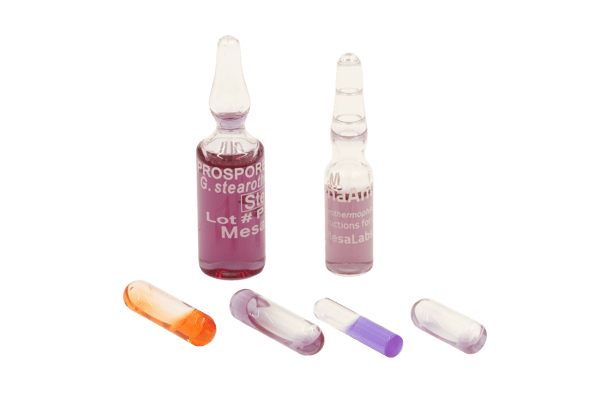
Figure 1. Overview of Mesa Labs’ liquid biological indicators (SterilAmp®, MagnaAmp®, and ProSpore®) designed for in container biological validation of steam sterilized liquids.
With these self-contained BI formats, Mesa Labs can address most validation needs for liquid product containers such as prefilled syringes, vials, bottles, bulk containers, and a variety of other configurations used in pharmaceutical and medical device manufacturing. Nonetheless, some liquid product containers present unique challenges for biological validation, not due to the validation method, but due to physical limitations of BI placement within the container.
When container diameter restricts placement of biological indicators
In certain cases, extremely small container diameters or narrow access ports make it impossible to insert standard BI ampoules into the container. When this physical limitation occurs, meeting regulatory expectations for in container biological validation becomes difficult, often leading validation teams to use direct inoculation or surrogate methods instead.
This challenge is most seen with:
-
1 mL prefilled syringes
-
Cartridge-based delivery systems (such as dental and anesthesia cartridges)
-
Narrow-neck ampoules and small vials
-
Parenteral (IV) fluid bags with small administration or injection ports
Standard mini liquid biological indicator ampoules (~6.5–6.8 mm diameter) are typically unable to access these geometries, creating a limitation for representative in container placement.
When standard BI ampoules cannot be placed inside these containers, validation teams are compelled to adopt alternative validation strategies. This situation is particularly relevant when physical constraints prevent representative in container placement at the most difficult-to-sterilize location.
Common workarounds—and why they create risk
One common workaround is direct product inoculation using a spore suspension. While this approach remains essential during development phases, particularly for D value determination and understanding product impact on spores, it is difficult to apply in routine or periodic process validation. Controlling inoculum homogeneity, stability, and resistance requires time, expertise, and often external laboratory capabilities, introducing variability and uncertainty.
Other workarounds include:
-
Using larger surrogate containers
-
Modifying the original container (opening, cutting,
resealing) -
Modifying containers or adapting access points to enable BI insertion
Although technically feasible, these approaches typically involve more handling, higher variability, and increased contamination risk. They also make validation studies harder to justify and defend during inspections and
requalification.
In practice, all these strategies exist because one key element was missing: a standardized, compliant liquid BI small enough to fit into very small access diameters.
Enabling compliant biological validation for small diameter liquid containers
SterilAmp Micro/5mm was developed to fill this gap. SterilAmp Micro/5mm (Figure 2) is a self contained liquid biological indicator intended for terminal steam sterilization of liquids in very small primary containers.
The key change is simple: a reduced diameter—5.0 mm.

Figure 2. SterilAmp Micro/5mm self‑contained liquid biological indicators. Visual readout based on color change (purple to yellow) indicating microbial growth after incubation.
By reducing the BI diameter, SterilAmp Micro/5mm allows the same in container biological validation approach used with standard SterilAmp formats to be applied in very small liquid product containers where access was previously not possible (Figure 3). This enables placement of the biological challenge directly at the critical thermal location in the liquid, without surrogate containers or indirect methods.
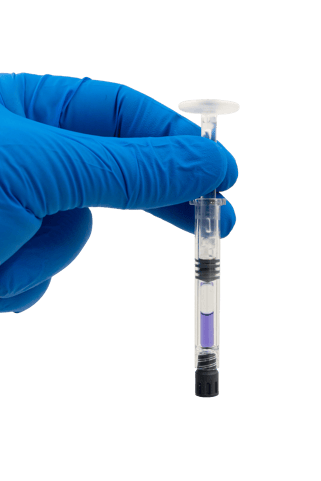
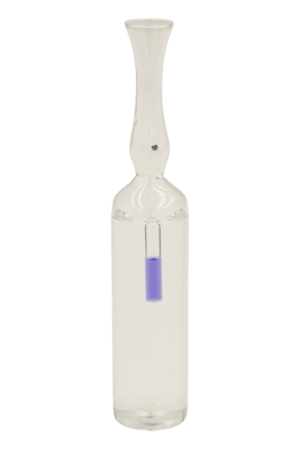
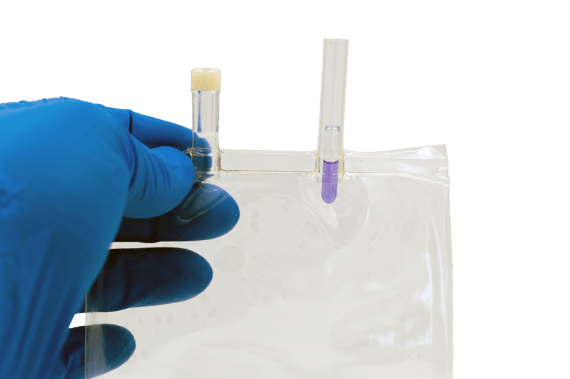
Figure 3. Examples of constrained geometries (from left to right:1 mL syringe, narrow‑neck ampoule, and parenteral [IV] fluid bag port) where SterilAmp Micro/5mm enables direct in‑container placement relative to standard biological indicators.
Implications for biological qualification and validation
SterilAmp Micro/5mm enables users to save time and cost by:
-
Moving away from difficult to control methods (manual inoculation, surrogate containers, container modifications)
-
Moving an ISO 11138 3 compliant BI with defined population, resistance, homogeneity, stability, and validated shelf-life with full traceability
-
Placing the BI at the critical thermal center without altering the container
-
Supporting robust, repeatable, and compliant validation
-
Reducing operational risks and rework
For Quality Assurance and validation teams, this means:
-
Representative biological challenge placement inside the liquid product container
-
More reproducible results with reduced variability
-
Validation studies that are simpler to design, execute, and justify
Key considerations for biological qualification and validation
Confirmation that the selected biological indicator represents an appropriate challenge for the sterilization cycle requires determination of the D value of spores in direct contact with the product (product D value study) to demonstrate correlation between BI resistance and product resistance.
Mesa Labs can support these critical D-value and validation studies, leveraging experience from more than 500 products tested. This expertise helps minimize variability related to methods, materials, and execution, supporting robust and defensible validation strategies.
For validation studies, SterilAmp ampoules should be placed inside identical liquid product containers filled to the same level as the final product, with BI locations selected based on thermocouple studies targeting the\ most difficult to sterilize (worst-case) locations.
When working with very small liquid volumes (e.g., 1–2 mL), ampoule displacement should be considered; SterilAmp Micro/5mm displaces approximately 0.4 mL of distilled water, enabling their placement in a container without significantly affecting thermal behavior.
Standards & Compliance
SterilAmp Micro/5mm is manufactured in compliance with:
-
ISO 11138-1
-
ISO 11138-3
-
USP
-
Ph. Eur.
-
Mesa Laboratories’ quality system
It is suitable for process qualification, validation, and routine monitoring of steam sterilization of liquids in globally regulated environments, particularly where container geometry limits standard BI placement.
Small diameter. Simple validation. Confident results.
Reorder# SAM/6
References
-
USP <1229> Sterilization of Compendial Articles,
Sections <1229.2> and <1229.5> -
ISO 17665:2024 Sterilization of health care products
— Moist heat — Requirements for the development,
validation and routine control of a sterilization process
for medical devices -
ISO 11138-7:2019 Sterilization of health care products
— Biological indicators — Part 7: Guidance for the
selection, use and interpretation of results -
European Pharmacopoeia (Ph. Eur.),11th edition